
Checking Criminal History in Okeechobee
Start with Okeechobee Police Records when an event occurred inside city limits and city officers created the report. The clerk accepts requests by telephone, email, or at the counter. No city arrest blotter, police case-search portal, or structured request form was located. Give a date, location, report number, or another precise detail.
Move to county sources for custody and prosecution. Adults go to Okeechobee County Jail, while the Clerk holds the County or Circuit Court file. Use FDLE for a statewide name search or fingerprint-supported Personal Review.
- Contact Okeechobee Police Records for the city report.
- Provide the date, place, involved name, or incident number.
- Call the county jail for booking, bond, and status.
- Search the clerk docket for filed charges and the result.
- Use FDLE when a statewide record is needed.
Okeechobee Police Records Counter
Police Records Clerk Caya Ortega is custodian for traffic incidents and police or FDLE reports. Request by PoliceRecords@cityofokeechobee.com, 863-763-3372 extension 9788, or at the counter, Monday through Friday from 8:00 a.m. to 5:00 p.m.
Police Records
50 SE 2nd Avenue
Okeechobee, FL 34974
863-763-3372 ext. 9788
Ask for an existing record. The city need not create a new list or summary.
A request should distinguish a traffic incident from a criminal investigation and identify the desired format. Photographs, recordings, certified pages, and an ordinary report copy can carry different charges. The city's published schedule accepts cash, check, or money order. If estimated production exceeds $50, the city requires a deposit before completing the work.
Records staff may need to review the file before release. Active investigative facts, victim details, juvenile information, confidential sources, or protected identifiers can be withheld or redacted under Florida law. Ask for the cited exemption if part of a document is denied. A redacted copy remains useful for confirming the incident number, agency, date, and publicly releasable narrative.
Okeechobee Police Department Records
The Okeechobee Police Department has four rotating patrol squads. Its three-investigator CID handles follow-up, evidence processing, violent crime, felony property and person crimes, and internet crimes against children. School resource officers serve two local schools.
Communications operates at the county EOC and accesses FCIC and NCIC. Two officers serve on sheriff SWAT/SRT, while a narcotics investigator works with the county task force and DEA. Thus, a city event can create records at several agencies.
The official incorporated-place table confirms the sole municipality.
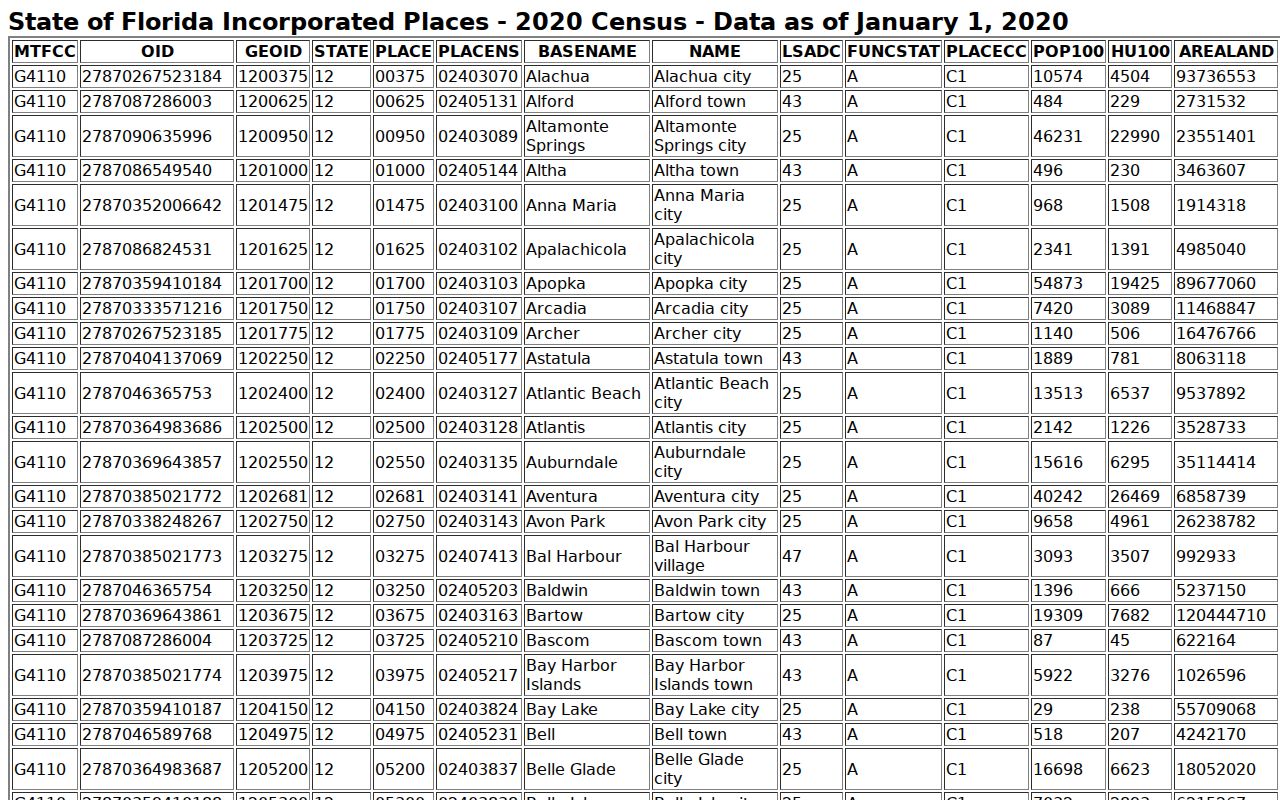
City boundaries determine when municipal police records exist.
Okeechobee Police Record Fees
The city records page publishes charges. Work past 15 minutes may add labor or technology costs; estimates above $50 require a deposit.
| Service | Fee |
|---|---|
| Black-and-white copy, one / two sided | $0.15 / $0.20 |
| Color copy, one / two sided | $0.50 / $0.75 |
| Certified copy | $1 per page |
| Homicide report | $25 |
| CD or DVD | $10 |
| Resident / nonresident fingerprint | $5 / $7 |
| Other police background check | $5 |
The source shows conflicting $2 and $10 crash-report fees. Confirm that item first.
Okeechobee Arrests and Bookings
Okeechobee has no city jail portal. Adults go to Okeechobee County Jail. Call 863-357-5343 for releasable bond, listed charge, and status information. Juveniles go to St. Lucie Regional Juvenile Detention Center at 772-468-3940.
A booking charge can change after prosecutor review, and release does not close the court case. Compare incident, booking, filing, and disposition dates. The county Arrest Lookup covers custody channels.
Okeechobee Crime Data Context
FDLE's historical 2020 legacy-UCR table recorded 219 index crimes for a reporting population of 5,688: zero murders and rapes, two robberies, eight aggravated assaults, 19 burglaries, 175 larcenies, and 15 vehicle thefts. The rate was 3,850.2 and clearance 13.2 percent.
These are historical figures, not a current safety score, and later NIBRS data use different methods. Statistics summarize categories. Person-level records still require a report, booking, case, or repository search.
The reporting table also cannot answer whether a named person was arrested, charged, convicted, or cleared. Clearance is an agency measure, not a court judgment. One cleared incident can involve more than one person, and a prosecution can result in amended charges or dismissal. Use the data only for historical city context, then consult the specific record custodian for an individual event.
Municipal Court Records in Okeechobee
The city has no municipal criminal court. Traffic, ordinance prosecutions, misdemeanors, and felonies route to County or Circuit Court through the clerk. Circuit Court handles felonies; County Court handles misdemeanors and other matters in its jurisdiction.
The Code Enforcement Special Magistrate is administrative, not criminal. Hearings occur as needed on the second Tuesday at 6:00 p.m. at City Hall.
| Court Name | Okeechobee County Court and Nineteenth Judicial Circuit Court. |
|---|---|
| Case Types Heard | Traffic, ordinances, misdemeanors, and felonies by jurisdiction. |
| Case Lookup Channel | Clerk search, daily docket, counter, or request. |
| What the Docket Shows | Charges, events, pleas, dispositions, judgments, and sentences. |
| Copies & Fees | Ordinary or certified clerk copies. |
Laserfiche Is Not a Rap Sheet
City Laserfiche searches administrative documents. It has one text field and a Search button. Quotation marks search an exact phrase. There are no person-name, birth-date, police-report, arrest, or case fields.
| Field | Use |
|---|---|
| Enter a word or phrase | Search existing city documents |
| Search | Run the query |
The official records page shows this route.
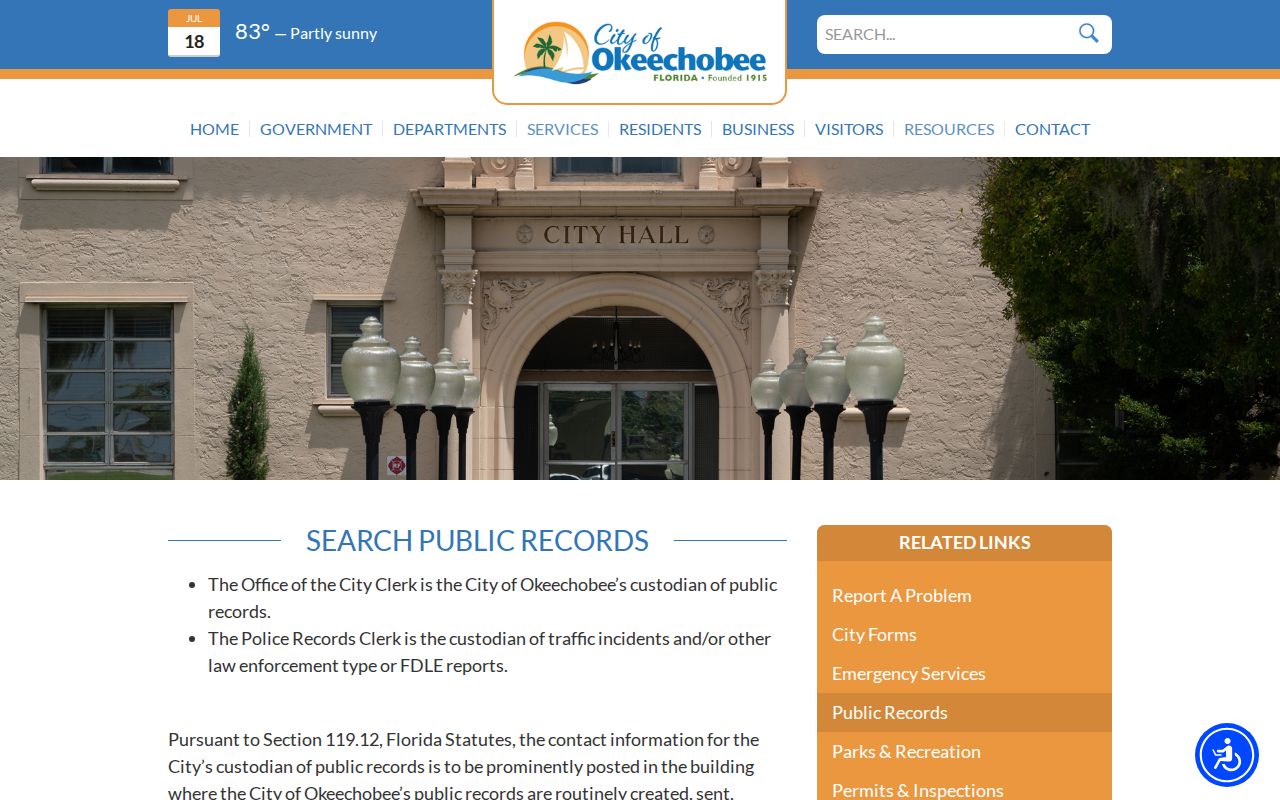
For person records, use police, jail, or court sources.
Where Okeechobee Records Go
A city report stays with police. OCSO creates an adult booking, prosecutors decide charges, the clerk maintains the disposition, and reportable data reaches FDLE.
Record flow: Okeechobee Police › Okeechobee County Jail › County or Circuit Court › Florida Department of Law Enforcement
Recent events can exist before a court case. Older matters require the final clerk outcome. A missing FDLE outcome should be checked against a certified disposition.
Okeechobee City Record Boundaries
The city incorporated in 1915. Historic City Hall dates to 1926, and the city sits at US 441 and SR 70. It calls itself the Gateway to South Florida and marks local life through the Speckled Perch Festival, rodeo, fair, and cattle drive.
The city contracts county fire service but keeps its police department. Officers cover streets and major highways. A single event may thus involve city police, county custody, county courts, and shared teams. Confirm the location and creating agency.
Cross-Check Okeechobee Criminal Records
A sound city search follows the document rather than the person's name alone. Police hold the narrative and evidence-related report. The jail holds intake, bond, housing, and release data. The clerk holds what prosecutors filed and what the judge decided. FDLE compiles reportable state history. These sources can contain different charge language without any source necessarily being wrong, because each captures a separate point in the case.
Dates need the same care. Arrest can precede booking. Filing may occur later, and disposition can come months afterward. A case can stay visible after release. Police can retain a report after dismissal unless sealing, expunction, or another lawful restriction changes access. For a recent event, check city police and county booking first. For a resolved matter, give priority to the clerk's final disposition.
If a statewide record seems incomplete, obtain the certified Okeechobee court outcome before asking FDLE to review its entry. FDLE Personal Review uses fingerprints to connect a person with the repository record and provides a challenge path. A routine name search lacks that identity assurance. This is especially important for common names, spelling changes, aliases, or records that list incomplete biographical data.
Federal and state custody are separate again. The Florida Department of Corrections search applies after a person enters state prison or state community supervision. A federal case or sentence can require PACER and the Bureau of Prisons locator. Neither source replaces the city report or Okeechobee clerk docket. Search outward only when the known case path supports it.
Describe an Okeechobee Police Record
A focused request is more useful than asking for every record tied to a broad subject. Give the incident date or a tight date range, the street or intersection, the report number if known, and the names of involved people. State whether the desired item is an incident report, traffic report, arrest affidavit, photograph, recording, or certified copy. The custodian can then identify the existing file, estimate copy and labor charges, and review the correct material for exemptions.
Some information may be withheld even when the rest of a report is released. Active investigative details, protected victim information, juvenile material, confidential sources, and exempt personal data can require redaction. A redacted report is not proof that the omitted information is adverse. It means the custodian applied an access restriction to that part of the public copy.
City Laserfiche cannot substitute for this request. It searches documents that are already indexed in the city's administrative repository and does not build a person history. Likewise, the county clerk cannot supply a city police narrative it never created. Sending each request to the actual custodian reduces delay and preserves the difference between an allegation, a booking, and a court result.
When the incident number is unknown, begin with the tightest date and location possible. City traffic officers cover local streets as well as the major state highways crossing downtown, so a highway reference can help identify the event. If another agency led the investigation, Okeechobee Police may direct the requester to that custodian rather than reproduce a partner agency's complete file.
Public Access Rules in Okeechobee
City custodians provide nonexempt existing records. They may redact active-investigation, victim, juvenile, sealed-record, confidential-source, and protected personal information. The clerk applies court rules to judicial files.
Clear details help locate the file and price the request. Ask for the legal basis when access is denied. Broader routes appear on the county criminal history overview.
Public access also does not guarantee that every document is posted online. The police department offers telephone, email, and counter requests because no city criminal-case portal or arrest blotter was found. Court images may be restricted even when docket entries remain visible. When an online result lacks the needed document, contact the named custodian and request inspection, an ordinary copy, or certification as the purpose requires.
Key Statutes:
Florida Public Records Act, § 119.07 - governs inspection, copying, fees, and exemptions.
Florida Statutes § 943.053 - governs criminal-history dissemination.
Florida Statutes § 943.059 - governs sealing.