
Okeechobee County Criminal Court Cases
Okeechobee County belongs to Florida's Nineteenth Judicial Circuit. Circuit Court hears felony prosecutions. County Court hears misdemeanors and criminal traffic matters within its authority. Both use the Okeechobee County Judicial Center, and the Clerk of the Circuit Court and Comptroller keeps both sets of files. The City of Okeechobee has no separate municipal criminal court, so a city arrest that leads to charges also enters this county court system.
The file starts when the prosecutor submits a charging instrument. It then grows through notices, hearings, motions, pleas, orders, judgment, and sentence. That makes the Clerk's file different from an OCSO arrest affidavit. The affidavit records an officer's basis for an arrest. The docket records what charge was filed and how the court resolved it. Search both court levels if the charge degree is unclear.
Okeechobee Criminal Cases in Civitek
The official starting point is the Clerk's Public Search page. It routes readers to the Civitek Court Case Search and also lists Daily Court Dockets. Use a case number when available because it identifies one file. A name search can return people with similar names, so compare the middle name or initial, filing date, case type, and charge before selecting a result.
Civitek's live controls can change. The research confirmed party-name and case-number routes but did not confirm every visible form label. Do not assume a blank search proves there was no arrest or older case. Charges may not have been filed, a spelling may differ, or access may be restricted. Call the Clerk at (863) 763-2131 when an indexed matter or document image cannot be found.
Searching Okeechobee County Case Records
Begin at the Clerk's own landing page instead of a commercial name-search service. Confirm the county, court level, and criminal case type. Read the docket in date order, since the arrest charge, filed charge, and final judgment can differ. The Clerk counter and E-Certify channel supply documents that are unavailable as ordinary portal images.
- Open the Clerk's Public Search page and choose Court Case Search.
- Enter the Okeechobee case number, or search by the party's full name.
- Compare the filing date, court, case type, and charge on each possible match.
- Read the full chronological docket through the most recent entry and disposition.
- Request a missing image or certified instrument from the Clerk by case number and docket title.
| Field Label | Type | Required | Notes |
|---|---|---|---|
| Party name | Search mode | No | Compare the full name and case details; exact live controls may change. |
| Case number | Search mode | No | The most precise route when the number is known. |
| Daily Court Dockets | Separate link | No | Shows scheduled matters; calendars can change. |
| Case detail | Result | Yes | Confirm Okeechobee, criminal case type, filing date, and charge. |
Okeechobee Criminal Case Copies
A docket index does not guarantee that every filed image can be downloaded. Ask for the exact instrument by case number, docket date, and title. The Clerk is at 312 NW 3rd Street, Okeechobee, Florida 34972, and serves the public Monday through Friday from 8:30 a.m. to 5:00 p.m. Call before visiting to confirm current copying or certification charges.
Clerk E-Certify is the appropriate official channel when a certified electronic copy is needed. An ordinary browser printout is useful for research but is not a certified record. Public access also differs from the access given to a party, attorney of record, judge, or justice agency. Those role differences do not mean that a public user should seek restricted content through another source.
Inside an Okeechobee Criminal Case File
The Okeechobee County criminal case file connects the accusation to the result. Read the charging document and the final judgment together. Docket entries mark activity, but the filed order or judgment gives the controlling text when it is public. Financial entries can show court-ordered sums without explaining every underlying event.
| Case Number & Court | Identifies the Okeechobee file and whether County or Circuit Court handled it. |
|---|---|
| Charging Document | States the charge the prosecutor filed, which may differ from the arrest allegation. |
| Docket Entries | Chronological index of filings, appearances, motions, orders, and case events. |
| Hearing Dates | Past and scheduled proceedings, subject to calendar changes. |
| Disposition & Judgment | Records dismissal, plea, trial result, adjudication, or other final action. |
| Sentence & Conditions | Shows the court's punishment, supervision, and financial obligations when entered. |
Okeechobee Arrest and Filed Charges
An OCSO booking entry reflects the alleged charge known at intake. The Nineteenth Circuit State Attorney then decides what to file. The filed information may narrow, replace, or omit an arrest allegation. Later, a plea, dismissal, acquittal, or judgment may change the legal outcome again. That sequence explains why one event can produce several different charge labels without any record being a duplicate.
Use the creating agency's affidavit to understand the stated basis for custody. Use the Clerk file to see the prosecution and result. If statewide history lacks the disposition, obtain the certified Clerk disposition before using FDLE's fingerprint-supported Personal Review and challenge process. Silence in one system should never be used to guess the outcome in another.
How an Okeechobee Criminal Case Moves
The court trail starts with charges filed by the State Attorney, not with the complete police investigation. At arraignment, the accused is advised of the charge and enters the appropriate plea. Pretrial work can include discovery, motions, bond review, and negotiated resolution. A plea or trial leads to disposition. Sentencing follows when the outcome calls for it.
Case flow: Charges Filed › Arraignment › Pretrial › Plea or Trial › Disposition › Sentencing
Okeechobee felony procedures identify Courtroom A for evidentiary hearings and require documents to be filed through the Clerk. Always read the actual docket because a case can close, reopen, move to appeal, or produce later supervision entries.
Okeechobee Appeals in ACIS
Once an Okeechobee criminal matter reaches appeal, use the Florida Appellate Case Information System. ACIS provides Case Search, Party Search, Oral Argument Search, and Advanced Search for the Florida Supreme Court and six District Courts of Appeal. Public searching does not require registration.
ACIS is not a statewide trial-court search. Start with the Okeechobee Clerk for the lower-court file, then use the lower-tribunal number to connect it with the appeal. The source-linked image below shows the official appellate channel, which adds the appeal docket without replacing the county record.
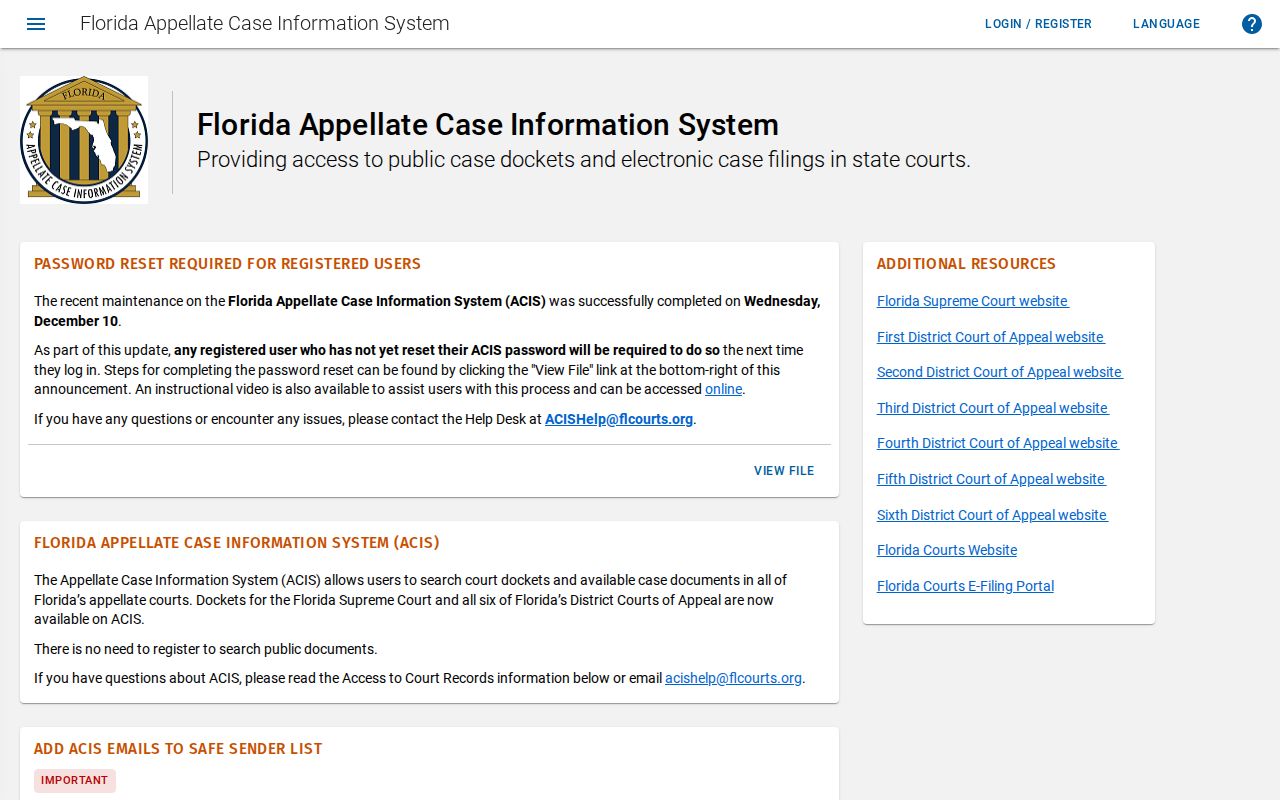
The two dockets answer different questions and should be read together.
Okeechobee Criminal Court Recordings
Florida's court-reporting standards explain that county criminal proceedings generally use digital reporting. Circuit criminal matters may use digital or stenographic reporting, while capital and circuit criminal trials receive stenographic treatment. A recording is separate from the Clerk's filed-document set.
Public audio or video copies must pass confidentiality review. Requesters should identify the case, hearing date, and proceeding instead of asking for an entire undefined history. The official standards appear in the image below and help explain why a docket entry for a hearing does not itself contain a transcript or recording.
The Clerk docket remains the index used to identify the event before a recording request.
Okeechobee Case Record Access Restrictions
Florida Rule of General Practice and Judicial Administration 2.420 makes judicial records presumptively public unless the constitution, a statute, a court rule, or an order protects them. Rule 2.425 requires filers to minimize sensitive information. Sealed, expunged, juvenile, victim-protected, and other confidential material will not appear as ordinary public portal content.
The Florida Courts rules index is the source for these access standards. Its official page appears below. A missing image may call for a focused Clerk request, while a confidential record calls for the process allowed by law.
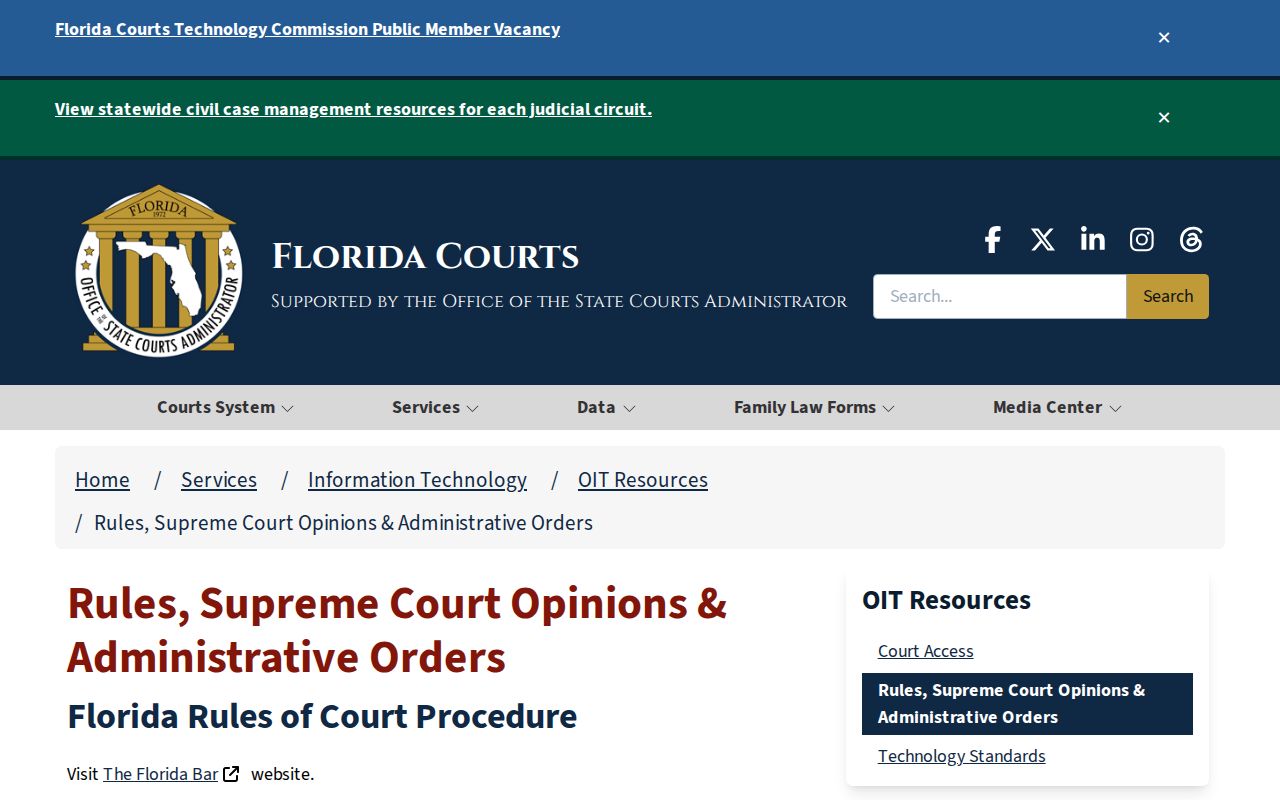
Neither portal silence nor a redacted view proves that an event never occurred.
Florida Public Records Law and the court rules operate in different record settings. Chapter 119 governs agency records, including releasable sheriff material. Rule 2.420 governs judicial records. A request for an arrest affidavit belongs with the creating law-enforcement agency, while a request for a filed information, judgment, or sentencing order belongs with the Clerk. Sending one broad request to the wrong custodian can delay the answer.
When part of a public case document is protected, the available copy may contain redactions. Ask the Clerk whether the docket entry exists, whether a public image is available, and how to request a specific instrument. Do not ask staff to interpret the legal effect of an order. Read the signed order and seek legal advice when its effect matters.
Okeechobee court research is strongest when each claim is tied to a dated docket event. Record the case number, court level, filing date, document title, and latest disposition. Recheck scheduled hearings near the event because Daily Court Dockets can change. For historical or genealogical work, give the Clerk a useful name range and approximate year rather than assuming every old file has a modern image.
Keep a dated copy of the Okeechobee docket used for research, then confirm later hearings, dispositions, or reopening through the live Clerk record. Court calendars and case status can change after a saved printout.