
Checking Okeechobee County Criminal History
Begin with the record's custodian. The Okeechobee County Sheriff's Office public-services desk handles local criminal-history checks, fingerprints, inmate matters, and related services. The Clerk of the Circuit Court and Comptroller provides the trial-court case search. FDLE supplies the statewide Florida criminal-history product. Each answers a different question, so a name-only result should be matched by date of birth, case number, booking date, or another reliable identifier.
Use the narrowest source first. A police report explains an event. A booking entry states custody facts and intake charges. A clerk docket shows what prosecutors actually filed and how the court resolved the case. An FDLE result is broader across Florida but may still need a certified disposition from the clerk when an outcome is missing or unclear.
- Write down the full name, date of birth if known, approximate event date, and possible spelling variants.
- Check the sheriff or city police source for the report, booking, inmate status, or warrant question.
- Search the clerk's official case system and daily dockets for filed charges and court events.
- Compare identifiers and dates instead of assuming every matching name is the same person.
- Order a certified clerk record or an FDLE check when an official result is required.
Three Okeechobee Record Custodians
Okeechobee's core records offices sit close together, yet their files are not duplicates. The clerk at the Judicial Center holds criminal dockets, judgments, and certified court copies. OCSO keeps sheriff reports and county jail files. FDLE receives statewide criminal-history data from reporting agencies across Florida. Asking the right custodian prevents a common error: treating an arrest affidavit, jail entry, court docket, and state summary as one interchangeable record.
Clerk Criminal Records
312 NW 3rd Street
Okeechobee, FL 34972
Official case search and certified copies
OCSO Main Office
504 NW 4th Street
Okeechobee, FL 34972
863-763-3117
FDLE Repository
Statewide Florida criminal-history searches, certified products, and fingerprint-supported personal review.
The downtown layout makes in-person cross-checking practical, but office proximity does not merge legal custody. The sheriff cannot certify a court judgment that belongs to the clerk. The clerk cannot supply the investigative narrative created by a deputy or city officer. FDLE cannot correct a local disposition until the supporting court record is identified. Keep the case number, booking number, incident number, and state identifier separate when collecting documents.
The Okeechobee State Attorney's office is in Suite 260 of the Judicial Center and reviews law-enforcement allegations before deciding which counts to file. That review explains why wording on an arrest affidavit can differ from the later information or docket. The Public Defender's local office serves qualifying defendants, but defense files are not a public substitute for the clerk record. For a public search, follow the official record chain instead of asking one office to reconstruct another office's file.
Florida Official Background Checks
The Florida Department of Law Enforcement Florida Checks page separates its name-based Instant Search, certified or noncertified search requests, and fingerprint routes. The public Instant Search costs $24 per search. It depends on the name and identifiers supplied, so it can miss a match or return a possible match that needs closer review. A local OCSO check is not the same statewide product.
For review of your own Florida record, FDLE's Personal Review uses fingerprints and provides a process to challenge incomplete or inaccurate repository data. Registered LiveScan submitters capture electronic fingerprints for authorized checks. The correct product depends on whether the need is a quick name search, a certified record, or a fingerprint-supported self-review.
The Florida Commission on Offender Review is a separate source for parole and release matters. It does not replace FDLE's criminal-history repository or the clerk's court file.
Okeechobee FDLE Search Fields
FDLE's Instant Search works best when the searcher uses every reliable identifier available. Broad searches create more candidates and require careful comparison. The portal's result is a state repository response, not a certified copy of each underlying Okeechobee County pleading.
| Search detail | Why it matters | Follow-up source |
|---|---|---|
| Full name | Begins the name-based match | Compare clerk and booking identifiers |
| Date of birth | Separates people with similar names | Confirm against an official case |
| Race and sex | Refines possible matches | Do not rely on one field alone |
| Case outcome | May be absent or delayed | Request a certified clerk disposition |
Criminal Record Types
Okeechobee County criminal records describe different stages of the justice process. An allegation begins in an agency report. Custody creates booking data. A prosecutor's filing creates the court charge, and a judgment supplies the disposition. Supervision, prison, warrants, and registry duties are maintained through other systems. Dates can differ at every stage.
For that reason, a complete check often uses more than one office. The city police department keeps its own incident narratives even when OCSO books the person. The clerk remains the best source for the filed case. FDLE and the Florida Department of Corrections add statewide history and custody or supervision records.
- Arrest and booking records state the arresting agency, intake charges, bond, and custody status.
- Criminal court files show filed counts, hearings, pleas, orders, judgments, and sentences.
- State criminal history compiles reportable Florida arrests and dispositions.
- Warrants require current confirmation from the issuing court or sheriff's Warrant Unit.
- Supervision and registry records come from FDC, release authorities, FDLE, and local registration offices.
Okeechobee Jail Record Context
The Okeechobee County Jail has four housing units and 344 beds, with 75 corrections professionals and two negative-pressure rooms. Those details describe the facility, not public medical information about any person. The jail's booking line at 863-357-5343 can provide releasable charge, bond, and status information.
A jail release does not close a criminal case. Booking may appear before prosecutors file a case, while the clerk docket can remain public after release. For state prison or state community-supervision status, use the FDC Corrections Offender Network. The federal counterpart is the Bureau of Prisons inmate locator.
The official FDC search screen shows how statewide custody records differ from a local jail call.
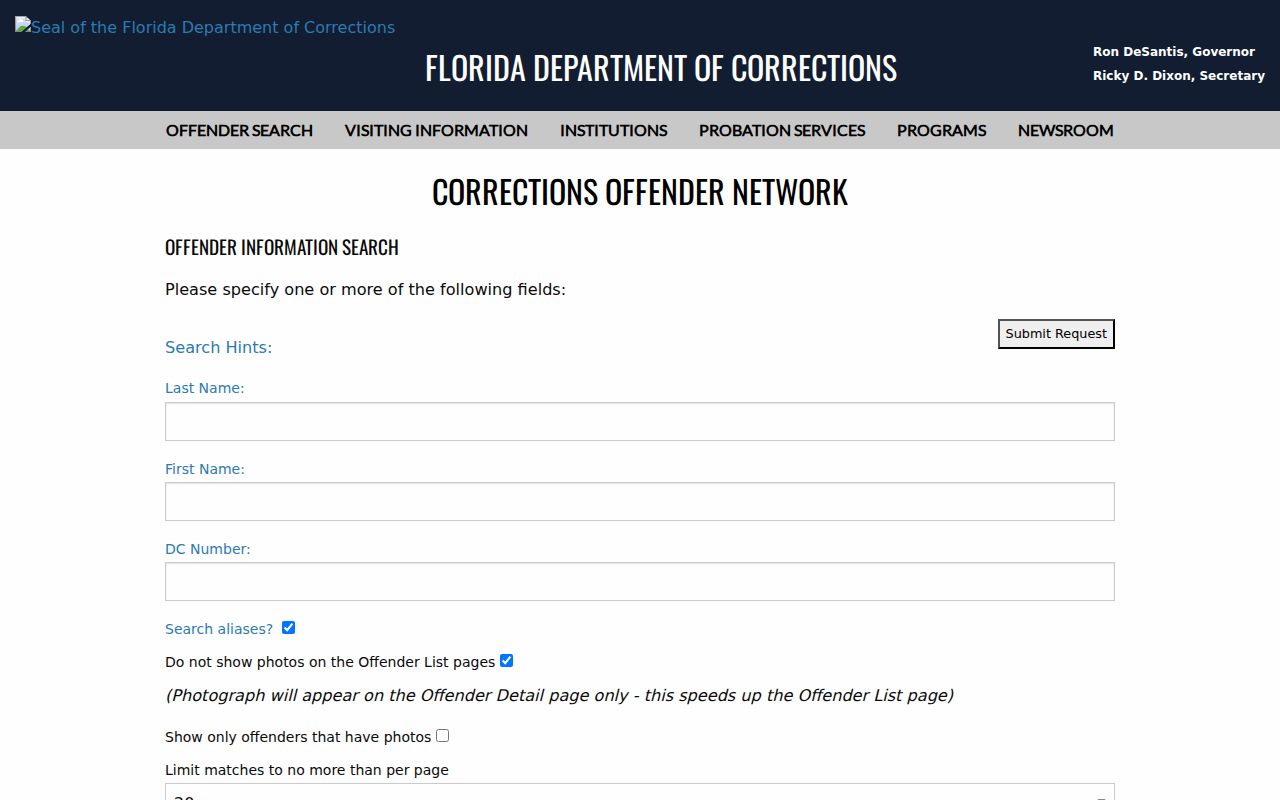
Use FDC only after a person reaches state custody or supervision; recent county bookings remain with OCSO.
Local visitation information also stays with jail reception. Appointments are handled through 863-357-5340, while the separate booking line answers releasable custody questions. Those numbers serve different functions. A visitation appointment does not verify a warrant or produce a court disposition, and the clerk does not manage jail housing or release processing.
Jail intake charges should be read as allegations recorded at booking. Prosecutors can decline a count, amend it, or file a different statutory charge after reviewing the evidence. Bond may also change through a later court order. When custody information and a docket appear inconsistent, compare their timestamps and then ask the responsible custodian for the current record.
Inside an Okeechobee County Criminal Record
The meaning of a field depends on its source. A booking charge reflects the reason presented at intake. The State Attorney may later file different charges. A disposition states the court's result, while a sentence describes the sanction imposed. Compare the subject's identifiers and case number before drawing any conclusion.
| Name & Identifiers | Legal name, aliases, date of birth, and agency identifiers used to distinguish records. |
|---|---|
| Arrest / Booking Data | Arresting agency, date, intake charge, bond, booking number, and release status. |
| Charges & Statutes | The offense language and Florida statute cited by police or prosecutors. |
| Disposition | The outcome of each filed count, such as conviction, dismissal, acquittal, or withholding of adjudication. |
| Sentence | Jail, prison, probation, fines, treatment, or other court-ordered terms. |
| Custody / Supervision Status | Current local jail, FDC prison, probation, or release-supervision information where public. |
Verify Okeechobee County Warrants
A free statewide lead is the FDLE Wanted Persons Search, but it is not a complete local warrant check. Call the OCSO Warrant Unit through 863-763-3117, extension 5031, for direct verification. Bench warrants arise from court proceedings, so the clerk docket is also important.
Do not approach or attempt to detain a wanted person. Anyone resolving their own possible warrant should confirm instructions with the responsible agency or a lawyer before appearing. A stale web result is not a substitute for current agency confirmation.
Public Access Laws in Florida
Florida's public-records framework generally allows inspection and copying of nonexempt agency records. It does not make every record open. Active-investigation material, confidential informant details, victim information protected by law, juvenile information, sealed files, and certain personal data may be withheld or redacted. The custodian should identify the basis for a denial.
Key Statutes:
Florida Statutes § 119.07 - governs inspection, copying, fees, redaction, and exemption handling for public records.
Florida Statutes § 943.053 - governs dissemination of Florida criminal-history information.
Florida Statutes § 943.0585 - sets Florida's court-ordered expunction framework.
Florida Statutes § 943.059 - addresses court-ordered sealing of criminal-history records.
OCSO Criminal Records Requests
OCSO accepts public-records requests through its GovQA request portal and the Public Information Office. A person involved in an incident can receive one courtesy copy of the related arrest affidavit or investigation report. Ordinary black-and-white copies cost 15 cents per single-sided page. Extensive research or technology time is charged at $15 per hour.
| OCSO service | Published charge |
|---|---|
| Involved person's courtesy report or affidavit | One copy free |
| Single-sided black-and-white page | $0.15 |
| Extensive research or technology work | $15 per hour |
Describe a real record with names, an approximate date, location, incident number, or case number. A focused request reduces research time and helps the custodian apply exemptions to the correct file.
Requests can cover an incident report, arrest affidavit, dispatch material, photographs, or another existing sheriff record, but availability varies with the file. An active investigation can protect details that may become available later. Victim information, juvenile material, confidential-source data, and exempt personal identifiers may be removed from the public copy. A partial release does not mean the original contains no additional material; it means the public version reflects the exemptions applied at that time.
For an involved person, the courtesy-copy policy can be the quickest route to the relevant affidavit or investigation report. A broad request for every mention of a name may require more staff research and produce unrelated matches. Supply the event date, address, deputy name if known, and report number. If the goal is proof of the case outcome, skip the report-copy route and order the judgment or certified disposition from the clerk.
Sealed, Expunged, and Restricted Records
Florida distinguishes sealing from expunction. Sealing restricts public access while certain justice agencies retain access. Expunction generally directs agencies to destroy or remove qualifying records from ordinary access, subject to statutory exceptions. Neither process happens merely because a charge was dismissed. Eligibility and the required certificate depend on the case history.
Start at FDLE's Seal and Expunge Process hub and review its certificate instructions. FDLE also lists common reasons for denial. After a certificate issues, the court filing and order remain distinct steps. Juvenile, victim, medical, and active-investigation materials may have separate restrictions.
Okeechobee Diversion Record Paths
Okeechobee Mental Health Court can combine treatment and supervision for eligible participants, with dismissal possible after successful diversion in qualifying matters. Journey Forward begins through the jail classification officer and links specialized-dorm substance-abuse treatment with post-release reentry. These programs matter to record readers because an arrest, filed charge, program entry, and final disposition may appear at different times.
The correct conclusion comes from the final clerk disposition, not from an earlier booking label. The Nineteenth Judicial Circuit's problem-solving courts information provides the court context, while the State Attorney and defense counsel handle eligibility and case decisions.
Okeechobee County Criminal Records by City
Okeechobee is the county's only incorporated municipality. City police keep traffic incidents and law-enforcement reports created inside city limits, but adults arrested there are booked into the county jail and criminal cases go to County or Circuit Court. Buckhead Ridge, Taylor Creek, and Cypress Quarters are not incorporated cities, so they do not receive city pages.
Okeechobee Criminal Records
2025 estimate: 5,811 · City police reports route to county booking and courts.
Okeechobee State Record Layers
State sources answer questions that county offices cannot. The FDLE Instant Search covers reportable Florida criminal history. The FDC locator covers state incarceration and supervision. FDLE's registry search covers registered sexual offenders and predators, while the national NSOPW portal adds a cross-state layer. None replaces the local court judgment.
The official Florida Checks page explains the repository products available for an Okeechobee County records search.
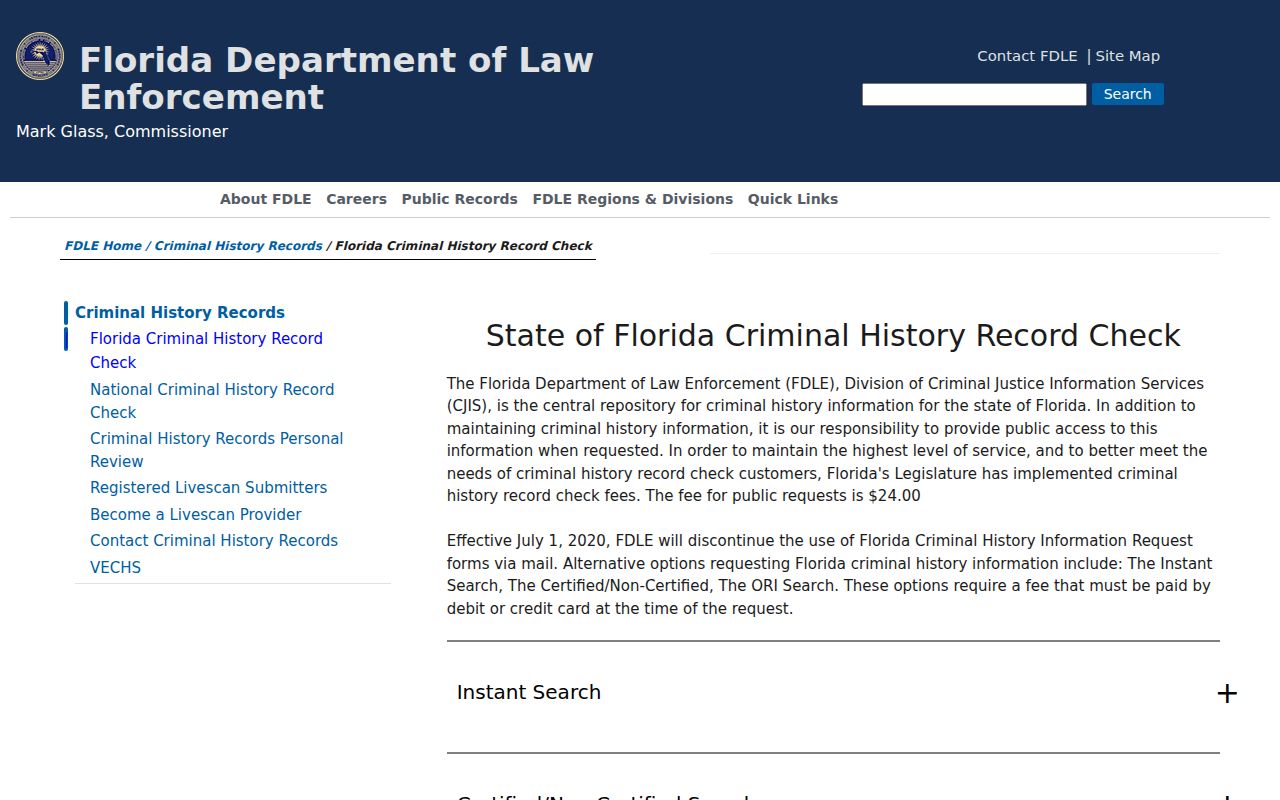
The product descriptions help distinguish an instant name search from a certified request and a personal fingerprint review.
The FDLE criminal-history search interface is the official statewide name-search channel.
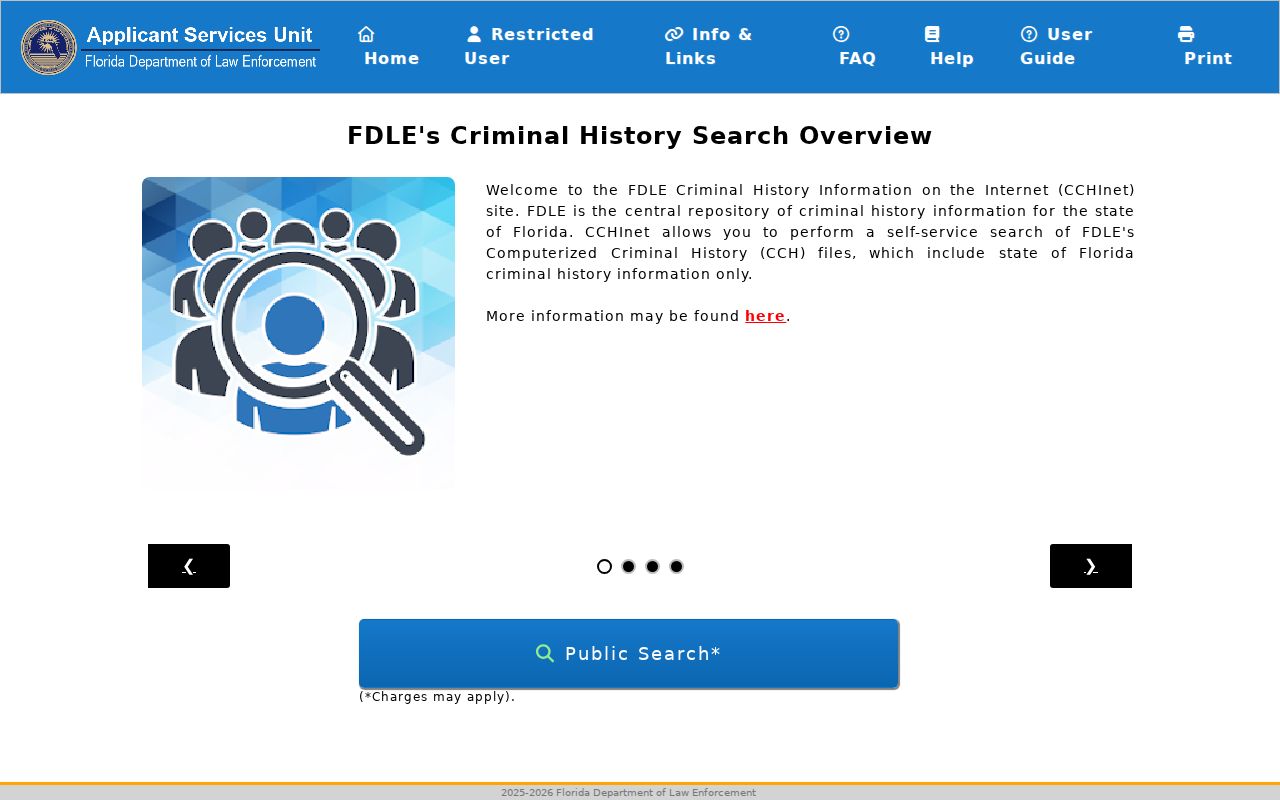
Searchers should still retrieve the Okeechobee clerk file when the disposition needs confirmation.
For a fingerprint-supported check, FDLE publishes its list of registered LiveScan submitters.
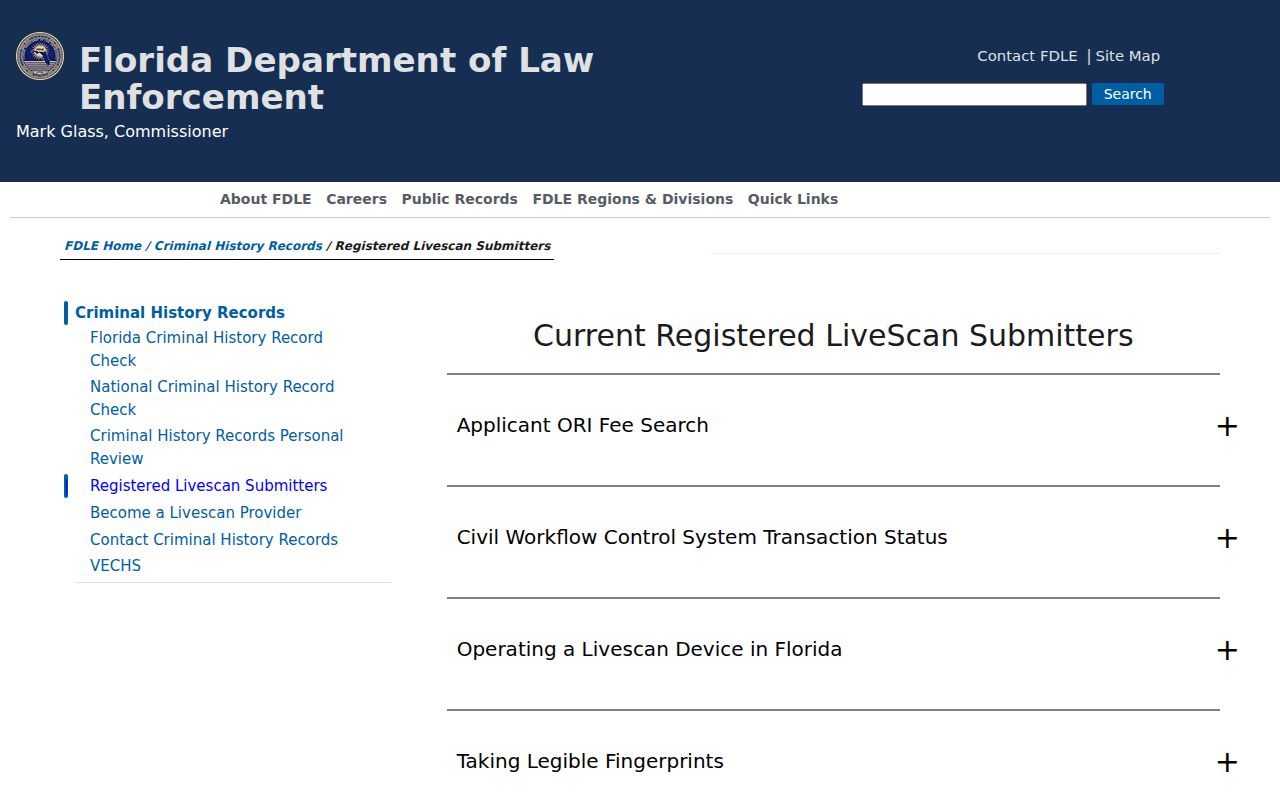
That list identifies approved capture channels without turning a local name search into a fingerprint match.
Community registry searches use the official FDLE offender search.
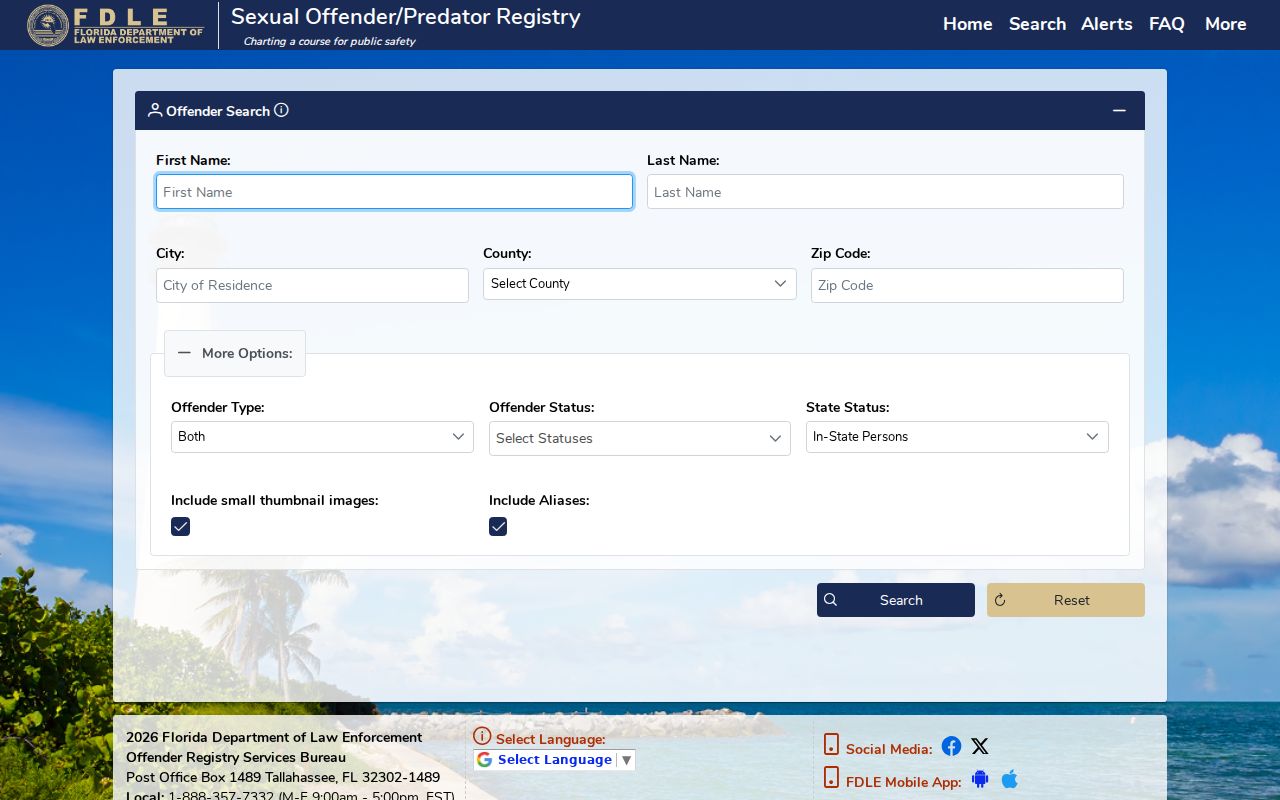
Registry information has a public-safety purpose and should be verified through the profile and local registration office.